What is Anxiety in an Evolutionary Context?
When we feel threatened, our body reacts with a stress response commonly called anxiety. Anxiety is the state of alertness we experience caused by an increase in the production of hormones/neurotransmitters such as cortisol and adrenaline. Our limbic system’s main objective is our survival and the perpetuation of the species. Faced with any danger that threatens our physical and emotional integrity, it reacts in a way that allows us to escape, fight, or freeze in the face of this threat, whether real or imagined, thus increasing our chances of survival.
Our ancestors led a life of strenuous physical activity. Faced with real dangers, their high caloric expenditure and long journeys perfectly counterbalanced the increase in the aforementioned hormones. In the current post-industrial era, we often find ourselves working eight hours a day under high stress, yet without the escape of physical activity that abounded in the lives of our hominid ancestors. Our diet has also been poorly adapted. In his book “In Defense of Food,” Michael Pollan tells the story of ten Australian Aborigines who renounced their traditional hunter-gatherer lifestyle in exchange for post-industrial modernity. The adoption of the Western diet resulted in the development of diabetes, among other inflammatory disorders such as Metabolic Syndrome.
Social Anxiety Disorder (SAD)
Social Anxiety Disorder (SAD), commonly called Social Phobia, affects approximately 5 to 13% of the world’s population at some point in their lives. It consists of excessive feelings of inadequacy, shame, shyness, a sense of judgment, among others. Physical symptoms may include tachycardia, sweating, tremors, nausea, and bowel and stomach problems (to be seen in Example 1). A recognized technique in the treatment of SAD, widely used by Cognitive Behavioral Therapy, is Exposure Therapy, where the individual is gradually exposed to their phobia, with appropriate professional monitoring. And that’s where Jiu-Jitsu comes in.
Jiu-Jitsu as a psychological tool
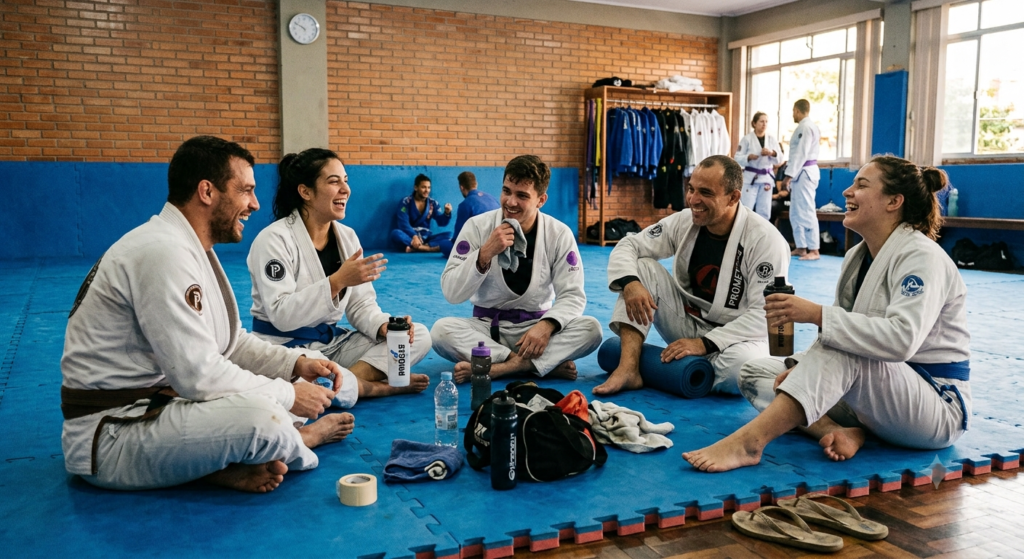
The Jiu-Jitsu environment promotes pre-established rules and social conduct that decrease the chances of an anxiety episode. Social Anxiety Disorder (SAD) is often caused by the anticipation of a situation perceived as threatening, so structuring a training routine tends to calm the limbic system (as demonstrated in Example 2).
Example 1: André is afraid of being embarrassed in his classroom; he feels he doesn’t know how to behave appropriately and that this is easily observed by other students. When thinking about the next time he will present himself to this group, André begins to catastrophize the encounter, anticipating scenarios and initiating the physiological processes that result in anxiety. Sweating begins, fear and adrenaline take over his body. If, upon entering the classroom, a student notices and comments on his sweating, his anticipation of the problem will be confirmed and the cycle will be complete. Then he will confirm what he feared and will likely repeat this cycle on occasions that have the same triggers.
Example 2: André makes the courageous decision to enroll in a reputable Jiu-Jitsu academy. After his first training session, which will possibly trigger the same stress response system seen in Example 1, André learns that he needs to arrive at the academy at a pre-determined time, properly uniformed, greet all his training partners, and follow the other rules. This structure tends to reduce the anticipation of situations considered embarrassing by André. The sporting practice itself forces him to focus on the present activity (warm-up, techniques, and fighting), making it difficult to anticipate future scenarios. The simple act of being present (Mindfulness) prevents him from catastrophizing the future.
Given his diagnosis of Social Anxiety Disorder, it would be reasonable to assume that André has a high level of Neuroticism, and because of this, his limbic system produces hormones that act to incite negative emotions such as anger, fear, shame, etc. The structure and rules of training soothe this “chimpanzee” that exists within us; our defense mechanisms are deactivated, and we can deal with the training environment for what it really is. This daily battle produces coping skills, and the learned behavior can then be adapted to other situations in our lives.
Generalization
In the first example, André may undergo a process of generalization, where what triggered his first episode of anxiety may reproduce the same symptoms in other social contexts. The good news is that the opposite is also true. If André creates new neural and behavioral pathways that are more adaptive during Jiu-Jitsu training, he can generalize his way of coping with stress on the mat and transfer this adapted behavior to his reality in another environment.
Example 3: André feels more confident now that he has been training Jiu-Jitsu for a few months. His anticipations of events considered embarrassing are not confirmed, his catastrophizing of social events does not seem realistic within his experience at the academy. André then decides to greet his university colleagues every day he enters the classroom. His change in behavior encourages his colleagues to greet him back and react positively to André’s presence. His social interactions that incite positive emotions begin to surpass his social interactions that incite negative feelings and emotions.
Conclusion
If we are conditioned to respond to a certain stimulus (smile, hug, attention from colleagues, etc.), we are more likely to respond in the same way when presented with similar stimuli. Stimulus generalization occurs when a behavior becomes more likely in the presence of a stimulus or situation. The structured environment and social interaction in Jiu-Jitsu help desensitize the client, reducing the impact of triggers that activate their anxiety episodes. Among many other benefits, Jiu-Jitsu serves as a powerful socialization tool that, with proper supervision, can be used in the treatment of disorders such as Social Anxiety Disorder.
Fobia Social e o Jiu-Jitsu
Quando nos sentimos ameaçados nosso corpo reage com uma resposta ao estresse comumente chamada de Ansiedade. A Ansiedade é o estado de alerta que experimentamos após aumento na produção de hormônios/neurotransmissores como o cortisol e a adrenalina. Nosso sistema límbico tem como principal objetivo a nossa sobrevivência e perpetuação da espécie. Frente a qualquer perigo que venha a ameaçar nossa integridade física e emocional, ele reage de forma que consigamos escapar, lutar ou congelar em frente a essa ameaça, seja ela real ou imaginária, aumentando assim nossas chances de sobrevivência.
Nossos antepassados levavam uma vida de atividade física extenuante. Frente a reais perigos, seu grande gasto calórico e longas jornadas contrabalanceavam perfeitamente o aumento dos hormônios já citados. Na atual era Pós-Industrial, muitas vezes nos encontramos trabalhando oito horas por dia com uma alta carga de estresse, porém sem o escape da atividade física que abundava na vida dos nossos ancestrais hominídeos. Nossa dieta também foi mal adaptada, no Livro In Defense of Food” Michael Pollan conta a história de dez Aborígenes australianos que renunciaram seu estilo de vida tradicional de caçador e coletor em troca da modernidade Pós-Industrial. A adoção da dieta ocidental resultou no desenvolvimento de diabetes entre outros transtornos inflamatórios como a Síndrome Metabólica.
O Transtorno de Ansiedade Social (TAS)
O Transtorno de Ansiedade Social (TAS) comumente chamado de Fobia Social atinge cerca de 5 a 13% da população mundial em algum ponto da sua vida. Ela consiste em sentimentos excessivos de inadequação, vergonha, timidez, sensação de julgamento, entre outros. Os sintomas físicos podem incluir: taquicardia, sudorese, tremores, náusea, problemas intestinais e estomacais (a ser visto no Exemplo 1). Uma técnica reconhecida no tratamento da TAS, amplamente utilizada pela Psicologia Cognitiva Comportamental, é a Terapia de Exposição, onde o indivíduo é gradualmente exposto a sua fobia, com acompanhamento profissional e adequado. E é aí onde entra o Jiu-Jitsu.
O Jiu-Jitsu como ferramenta psicológica
O ambiente do Jiu-Jitsu promove regras e comportamentos pré-estabelecidos que diminuem as chances de um episódio de ansiedade. A TAS é muitas vezes causada pela antecipação de uma determinada situação tida como ameaçadora, então estruturar uma rotina de treinos tende a acalmar o seu sistema límbico (demonstrado no Exemplo 2).
Exemplo 1: André tem medo de passar vergonha na sala de aula, ele sente que não sabe se comportar de maneira adequada e que isso é facilmente observado pelos outros alunos. Ao pensar na próxima vez que ele irá se apresentar para esse grupo, André começa a catastrofizar o encontro, antecipando cenários e iniciando os processos fisiológicos que resultam na Ansiedade. A sudorese se inicia, o temor e adrenalina tomam conta do seu corpo. Se ao entrar na sala de aula, algum aluno perceba e comente a respeito de sua sudorese, sua antecipação do problema será confirmada e o ciclo estará completo. André então confirmará o que temia e provavelmente repetirá esse ciclo em ocasiões que possuam os mesmos gatilhos.
Exemplo 2: André toma a corajosa decisão de se matricular em uma academia de Jiu-Jitsu de boa reputação, após seu primeiro treino, que possivelmente desencadeará o mesmo sistema de resposta ao estresse vistos no Exemplo 1, André aprende que precisa chegar na academia em um horário pré-determinado, devidamente uniformizado, cumprimentar todos os colegas de treino e seguir as demais normas. Essa estruturação tende a diminuir a antecipação de situações tidas como constrangedoras por André. A prática esportiva em si o obriga a focar na atividade presente (aquecimento, técnicas e luta), dificultando uma possível antecipação de cenários futuros. O simples ato de estar presente (Mindfulness) impossibilita-o de catastrofizar o futuro.
Dado seu diagnóstico de Transtorno de Ansiedade Social, seria razoável presumir que André possui um alto grau de Neuroticismo, e por causa disso, seu sistema límbico produz hormônios que agem de forma a incitar emoções negativas como raiva, medo, vergonha etc. A estrutura e regra dos treinos acalenta esse “chimpanzé” que existe dentro de nós, nossos mecanismos de defesa são desativados e podemos lidar com o ambiente de treino pelo que ele realmente é. Essa batalha diária funciona gera um aprendizado e o comportamento aprendido pode passar a ser adaptado a outras situações das nossas vidas.
Generalização
No primeiro exemplo, André pode passar por um processo de generalização, onde os gatilhos que desencadearam seu primeiro episódio de ansiedade podem reproduzir os mesmos sintomas em outros contextos sociais. A boa notícia é que o contrário também é verdade. Caso André crie novos caminhos neurais e comportamentais que sejam mais adaptativos durante os treinos de Jiu-Jitsu, ele pode generalizar sua maneira de lidar com o estresse no tatame e transferir esse comportamento adaptado a sua realidade em um outro ambiente.
Exemplo 3: André sente-se mais confiante agora que já treina Jiu-Jitsu a alguns meses. Suas antecipações de eventos tidos como constrangedores não são confirmadas, sua catastrofização de eventos sociais não parecem realistas dentro da sua vivência dentro da academia. André então resolve cumprimentar os colegas da universidade todos os dias que entra na sala de aula. Sua mudança de comportamento estimula seus colegas a cumprimentá-lo de volta e reagir positivamente a presença de André. Suas interações sociais que incitam emoções positivas passam a superar suas interações sociais que incitam sentimentos e emoções negativas.
Conclusão
Caso sejamos condicionados a responder a um determinado estímulo (sorriso, abraço, atenção dos colegas, etc) apresentamos mais chances de responder da mesma maneira quando somos apresentados com estímulos semelhantes. A generalização de estímulo ocorre quando um comportamento se torna mais provável na presença de um estímulo ou situação. O ambiente estruturado e a interação social no Jiu-Jitsu auxiliam na dessensibilização do cliente, reduzindo o impacto dos gatilhos que ativam seus episódios de ansiedade. Entre muitos outros benefícios, o Jiu-Jitsu serve como uma potente ferramenta de socialização que, se utilizado de forma supervisionada, pode ser usado no tratamento de transtornos como o Transtorno de Ansiedade Social.
References:
“Consultoria em Psicologia do Esporte: Orientações Práticas em Análise do Comportamento” (1997) por Garry L. Martin.
“The Depression Cure” (2019) por Dr. Stephen Ilardi.
“The Chimp Paradox: The Mind Management. Program for Confidence, Success and Happiness (2012) por Steve Peters.